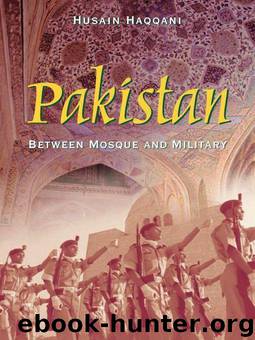
Pakistan: Between Mosque and Military by Husain Haqqani
Author:Husain Haqqani
Language: eng
Format: mobi, epub
Tags: Non-Fiction, bought-and-paid-for
ISBN: 9789780870034
Publisher: Carnegie Endowment for International Peace
Published: 2005-06-15T04:00:00+00:00
Ansari’s description shows a Zia ul-Haq who believed that his policies of Islamization at home would strengthen Pakistan against those conspiring to move Pakistan away from Islam. By codifying Islamic principles in the country’s constitution and legal system, Zia ul-Haq was paving the way for the day when “the lower rungs of society are mobilized in favor of greater Islamization.”74 At the same time, the Afghan jihad would make Pakistan “the instrument for the creation of an Islamic ideological regional block that would be the source of a natural Islamic revolutionary movement, replacing artificial alliances such as the Baghdad Pact. This would be the means of starting a new era of greatness for the Muslim nations of Asia and Africa.75
While Zia ul-Haq pursued an ideological dream in Afghanistan, U.S. objectives were more specific and somewhat limited. In Afghanistan, the United States hoped to roll back what had been an expanding Soviet influence in the third world. For the United States, Afghanistan was just the largest in a series of covert wars—others were being fought in Nicaragua and Angola—that were meant to punish the Soviet Union and inflict a heavy cost in men, money, and prestige. The CIA estimated that Soviet costs between 1981 and 1986 in Afghanistan, Angola, and Nicaragua amounted to about $13 billion.76 Soviet casualties in Afghanistan amounted to eighteen thousand dead and numerous wounded. By contrast, the United States spent $2 billion in covert aid to the Afghan resistance between 1980 and 1989 and lost no soldiers in its proxy engagement with the Soviets.
Once the United States decided to supply sophisticated ground-to-air missiles to the mujahideen in 1986, the Soviet Union’s one major advantage—airpower—against the mujahideen became ineffective. The mujahideen were described as “freedom fighters” in the international media, and their successes were a symbol of Soviet humiliation. By 1987- 1988, the United States had achieved its objective in Afghanistan, and the Soviets, now led by the reformer Mikhail Gorbachev, were willing to negotiate a way out of their Afghan quagmire.
In Pakistan, Zia ul-Haq held parliamentary elections in 1985 and appointed a civilian prime minister whom he expected to be weak and compliant. The new prime minister, Muhammad Khan Junejo, slowly extended press freedom and demanded the removal of martial law. Although Zia ul-Haq kept Junejo away from briefings about Afghanistan for almost a year,77 Junejo intervened in the conduct of Pakistan’s foreign policy. During an official visit to the United States in 1986, Junejo indicated to his American interlocutors that he would follow the U.S. lead in a negotiated settlement of the Afghanistan issue. He also directed his Minister of State for Foreign Affairs, Zaim Noorani, to forward cables from Pakistani embassies abroad to him first, before routing them to the president.78 Noorani, a politician like Junejo, agreed with the need to assert the civilian government’s role in international relations. Zia ul-Haq was not always informed first of routine diplomatic developments.
In 1986, Junejo also allowed Benazir Bhutto—daughter of former prime minister Zulfikar Ali Bhutto, the man Zia ul-Haq had overthrown and executed—to return to Pakistan from exile.
Download
Pakistan: Between Mosque and Military by Husain Haqqani.epub
This site does not store any files on its server. We only index and link to content provided by other sites. Please contact the content providers to delete copyright contents if any and email us, we'll remove relevant links or contents immediately.
| Arms Control | Diplomacy |
| Security | Trades & Tariffs |
| Treaties | African |
| Asian | Australian & Oceanian |
| Canadian | Caribbean & Latin American |
| European | Middle Eastern |
| Russian & Former Soviet Union |
The Secret History by Donna Tartt(19312)
The Social Justice Warrior Handbook by Lisa De Pasquale(12228)
Thirteen Reasons Why by Jay Asher(9009)
This Is How You Lose Her by Junot Diaz(6963)
Weapons of Math Destruction by Cathy O'Neil(6372)
Zero to One by Peter Thiel(5876)
Beartown by Fredrik Backman(5848)
The Myth of the Strong Leader by Archie Brown(5552)
The Fire Next Time by James Baldwin(5508)
How Democracies Die by Steven Levitsky & Daniel Ziblatt(5279)
Promise Me, Dad by Joe Biden(5192)
Stone's Rules by Roger Stone(5133)
A Higher Loyalty: Truth, Lies, and Leadership by James Comey(5020)
100 Deadly Skills by Clint Emerson(4975)
Rise and Kill First by Ronen Bergman(4841)
Secrecy World by Jake Bernstein(4805)
The David Icke Guide to the Global Conspiracy (and how to end it) by David Icke(4776)
The Doomsday Machine by Daniel Ellsberg(4557)
The Farm by Tom Rob Smith(4556)
